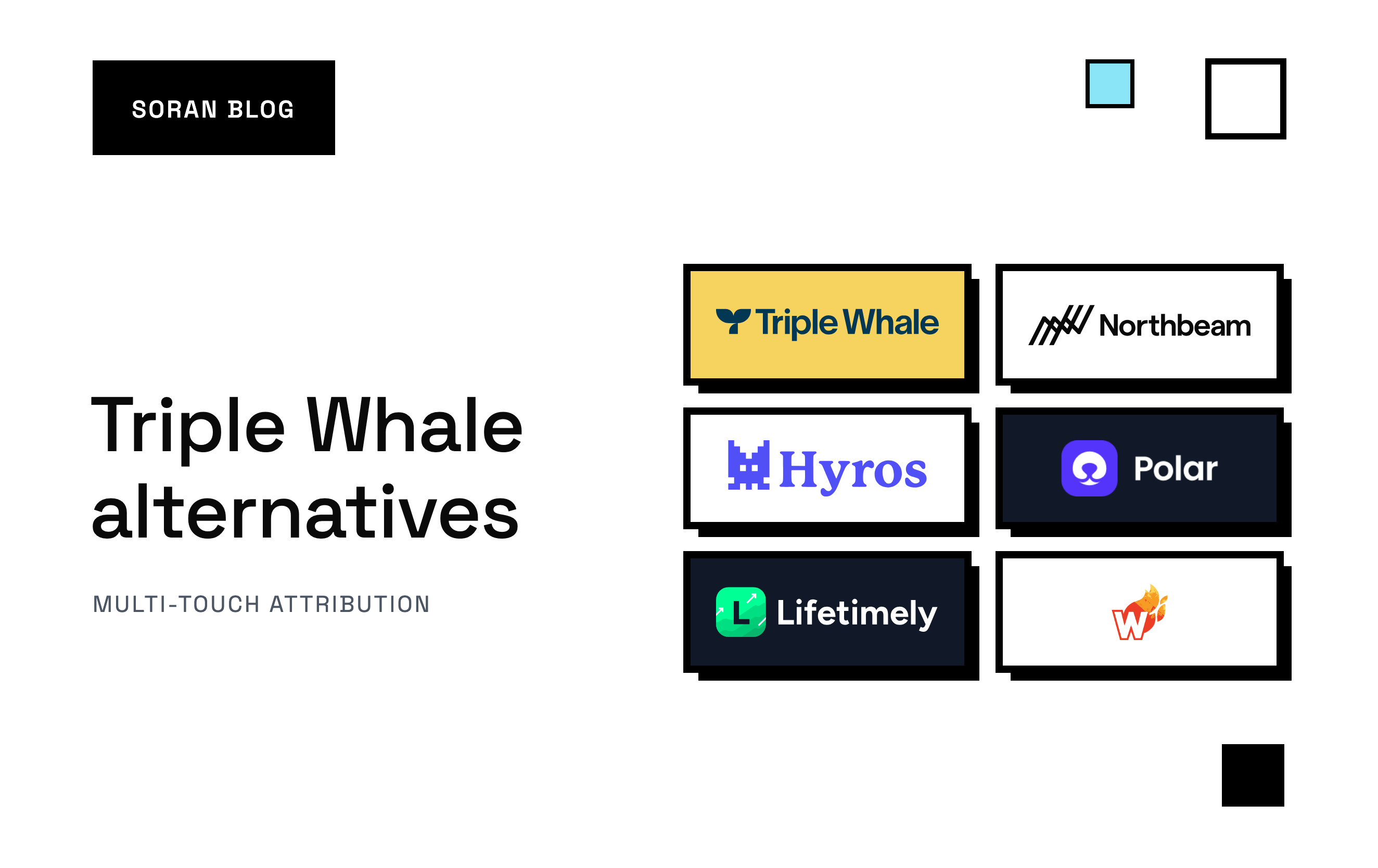
Maybe your Triple Whale renewal is coming up. Maybe you're about to sign up and want to know what else is out there. Or maybe you've used it for a while and you're still not sure the numbers match what your store actually made. Either way, you're weighing Triple Whale alternatives.
Whatever brought you here, the search usually comes down to one question: is there a tool that fits my store better? This guide answers that fairly. We'll cover what Triple Whale does well, why brands look elsewhere, the main competitors and what each is actually built for, and a short set of questions that will narrow your shortlist fast.
One disclosure up front: we make Soran, which is one of the alternatives. We've kept the comparisons to what each company publicly says about its own product, and we don't quote anyone's prices because they change often and depend on your store's size. Check each vendor's site for current details.
What Triple Whale is
Triple Whale is an analytics platform built for ecommerce brands, especially those on Shopify. It pulls your store data and your ad platforms into one place and adds its own tracking, which it calls the Triple Pixel , to follow visitors from ad click to purchase.
Its well-known pieces include:
- A summary dashboard that puts store revenue, ad spend and key ratios on one screen.
- Attribution, using its own pixel data to decide which ads drove sales, with several attribution models to choose from.
- Creative reporting for comparing ads.
- An AI assistant, called Moby, that answers questions about your data.
It's a broad product, and many brands are happy with it. People look at alternatives for reasons that are more about fit than flaws.
Why brands look at Triple Whale competitors
These are the reasons we hear most often. Not all of them will apply to you.
- Cost as they grow. Many analytics tools price by store revenue or order volume, so the bill rises as the business does. Brands sometimes want a flatter price.
- They want one clear answer, not many dashboards. A tool with lots of features can be more than a small team uses.
- The numbers still don't add up. Some brands want to see exactly how credit is split across channels, and check that channel totals match what the store took in.
- They care about profit, not just ROAS. ROAS (return on ad spend: revenue divided by ad spend) says nothing about margin. Some brands want profit by campaign and product front and center.
- Different needs. An agency running thirty stores, a brand that sells mostly through phone calls, or a team that wants its data in a warehouse (a central database for all of a company's data) all have different priorities.
What to compare in any Triple Whale alternative
Before looking at names, get clear on what actually separates these tools. Nearly all of them have a dashboard. The real differences are underneath.
How they track orders
The tool needs to see each visit and connect it to the order. Tracking that runs only in the shopper's browser loses data to ad blockers, browser privacy features and closed tabs. Server-side tracking records events from a server, a computer behind your store that the shopper's browser settings can't block, so fewer orders go missing. We explain the difference in server-side tracking for Shopify .
How they split credit
An attribution model is the rule for deciding which ads and channels get credit for a sale. Last click gives everything to the final click. Others spread it across every touchpoint (each ad click, email or visit along the way). What matters most is that each order's credit is handed out once, so the channel totals add up to your real revenue. If you can switch models and watch the numbers change, you can see how much your conclusions depend on the rule. Our guide to multi-touch attribution covers how this works.
Whether ad spend is matched to the exact ad
Some tools match spend at the campaign level. Others tie it to the individual ad behind each order, usually through tracking parameters (short tags added to the end of your ad links that say which ad the visitor came from). Ad-level matching is what lets you pause the one ad that isn't working instead of a whole campaign.
Whether they send data back to ad platforms
Meta, TikTok and other platforms learn who to target from the conversions they receive. Some analytics tools also send purchases back to these platforms, through services like the Meta Conversions API , so your ads optimize on more complete data.
Profit depth
Does the tool stop at revenue, or does it subtract discounts, refunds, product costs, shipping and payment fees to show what you actually kept?
Platforms and integrations
Check which store platforms and ad platforms are live today, not "coming soon." This is the fastest way to rule tools out.
The main Triple Whale alternatives
Here's how the main competitors describe themselves and who they tend to suit. These are high-level summaries, so treat them as a starting point for your own demos.
Northbeam
Northbeam focuses on attribution for brands with larger ad budgets. It combines tracking on your site with its own modeling to estimate each channel's contribution, and it also offers marketing mix modeling, a statistical method that estimates channel impact from spend and sales over time rather than from individual visits.
Tends to suit: larger brands spending across many channels, with someone on the team who wants to dig into modeling.
Polar Analytics
Polar Analytics is positioned as a business intelligence platform for ecommerce brands, meaning a tool for building your own reports and metrics from many data sources. It brings data from your store, ad platforms and other tools into one place, with an emphasis on custom reports and metrics.
Tends to suit: brands that want flexible, customizable reporting across many data sources.
Hyros
Hyros is a tracking and attribution tool that's popular with businesses selling through calls, webinars and longer sales funnels, as well as online stores. It emphasizes tracking leads and sales across a longer journey.
Tends to suit: businesses where sales happen over the phone or through multi-step funnels, not only a single checkout.
Wicked Reports
Wicked Reports focuses on attribution with an eye on repeat customers, crediting the ads that first brought a customer in for the purchases they make later.
Tends to suit: subscription and repeat-purchase brands that care about the long-term value of a customer.
Lifetimely
Lifetimely , now part of AMP, is built around profit and customer lifetime value for Shopify stores: what customers are worth over time and what you keep after costs. (Customer lifetime value is the total a customer spends with you over their relationship with your brand. See how to calculate your customer lifetime value .)
Tends to suit: brands whose main question is "what is a customer worth, and what did we keep?" rather than "which ad worked?"
Elevar
Elevar , now part of Audiense, is a tracking tool more than an analytics dashboard. It focuses on getting accurate data from your Shopify store into ad platforms and analytics tools, including server-side.
Tends to suit: brands that already have reporting they like and want to fix the data going into it.
Soran
Soran is attribution and profit analytics for ecommerce brands and the agencies that run them. It tracks orders on the server, works out which ads actually earned each sale, shows what you kept after costs, and sends those conversions back to ad platforms. More on it in its own section below.
Tends to suit: Shopify brands and agencies that want channel totals that match the store, profit by campaign and product, and one flat price.
A quick comparison by focus
| Tool | Main focus |
|---|---|
| Triple Whale | All-in-one ecommerce analytics and attribution |
| Northbeam | Modeled attribution for larger ad budgets |
| Polar Analytics | Custom business intelligence for ecommerce |
| Hyros | Tracking across calls and long funnels |
| Wicked Reports | Attribution with repeat-customer focus |
| Lifetimely | Profit and customer lifetime value |
| Elevar | Accurate tracking data into other tools |
| Soran | Attribution and profit that match the store |
How to choose: five questions
Answer these honestly and your shortlist will shrink to two or three.
- Which platforms do you need on day one? Write down your store platform and every ad platform you spend on. Rule out any tool that doesn't support them live today.
- What's the one question you want answered every morning? "Which ads earned money" points to attribution tools. "What did we keep" points to profit tools. "Is my tracking right" points to tracking tools. "I need every metric my way" points to BI tools.
- Do you need conversions sent back to ad platforms? If your Meta purchases undercount, this matters as much as the reporting.
- How does the price change as you grow? Ask each vendor how the bill changes if your revenue or order volume doubles.
- Can you check the numbers? On a trial, compare the tool's total revenue for a week with your store's. If they're far apart, ask why before you sign.
Mistakes to avoid when switching
Expecting past attribution on day one. Most tools can import your past orders, but the visit paths behind them only exist once the new tracking is installed. Run the new tool alongside the old one for a few weeks before you cancel.
Comparing two tools on different settings. If one uses last click and a 7-day window and the other uses a multi-touch model, the numbers will differ even if both are right. Match the model and window before comparing.
Forgetting about conversions sent to ad platforms. If your current tool sends purchases to Meta, removing it can quietly cut what Meta receives. Make sure the replacement takes over, and that you don't end up sending every purchase twice.
Choosing on the demo dashboard. Every demo looks good with sample data. Ask to see your own store's data during the trial.
How Soran handles it
If you're comparing Soran with Triple Whale, here's what it does, at the level you'd see it as a customer:
- Totals that match your store. Each order's credit is split once across the visits that led to it, so channel totals add up to what the store took, not the sum of every platform's claims. There are ten attribution models, and switching updates every number.
- Spend matched to the exact ad. Meta and TikTok spend is tied to the specific ad behind each order, with channel, campaign, ad set and ad views loading together.
- Honest ROAS. A channel with revenue but no spend is flagged as a probable unconnected ad account, not shown as a flattering number.
- Server-side tracking so ad blockers and closed tabs don't lose purchases.
- Profit down to contribution margin, per campaign and per product.
- Conversions sent back to ad platforms such as Meta and TikTok, with duplicates removed.
- Soran AI answers plain-English questions from your store's data and names the report it used.
- One flat price with no event, seat or volume limits, and a free trial with no card required.
To be fair about the gaps: Shopify is the only live store platform today, Google Ads spend and conversions are coming soon, attribution only starts once tracking is installed, and Soran doesn't offer marketing mix modeling or lifetime value cohort reports. If those are must-haves right now, another tool on this list may fit better.
Frequently asked questions
What is the best Triple Whale alternative?
It depends on your main question. For attribution that matches your store and profit by campaign, Soran is built for that (we make it, so test it against the others). For modeled attribution at larger budgets, Northbeam. For flexible custom reporting, Polar Analytics. For call and funnel businesses, Hyros. For fixing tracking data, Elevar.
Is there a cheaper alternative to Triple Whale?
Pricing changes and depends on your store's size, so compare current quotes directly. Ask each vendor how the price changes as your revenue or order volume grows, since that's where costs often differ most.
Can I switch from Triple Whale without losing data?
Your store's orders stay in your store, and most tools can import them. What doesn't carry over is the visit tracking history behind those orders. Run the new tool alongside Triple Whale for a few weeks so you have overlapping data before you switch off.
Do I need an attribution tool if I already use Meta's reports?
If Meta is your only channel and its numbers roughly match your store, maybe not yet. Once you run several channels, each platform claims credit for the same sales, and an independent attribution tool becomes the only way to see what each one actually earned.
Do these tools work with stores that aren't on Shopify?
Some do and some don't. Check the vendor's current integrations list. Soran currently supports Shopify only.
Comparing options? Book a demo and we'll show you Soran on your own store's data.