
Your ads look fine. ROAS (return on ad spend, the revenue your ads bring in for each dollar spent) is steady, revenue is up, the dashboards are green. And yet the bank account isn't growing the way it should. You're spending more every month and somehow ending up with about the same amount left over.
One of the most common reasons is that you're paying more and more to win each new customer, and the numbers you watch don't show it. Repeat buyers keep revenue looking healthy while the cost of bringing in someone brand new quietly climbs.
That cost has a name: customer acquisition cost, or CAC. This guide covers what it is, how to calculate it properly (with worked examples), why the "average CAC" figures you find online won't help you, and how to tell whether your number is healthy.
What is customer acquisition cost?
Customer acquisition cost is the average amount you spend to win one new customer.
The basic formula is simple:
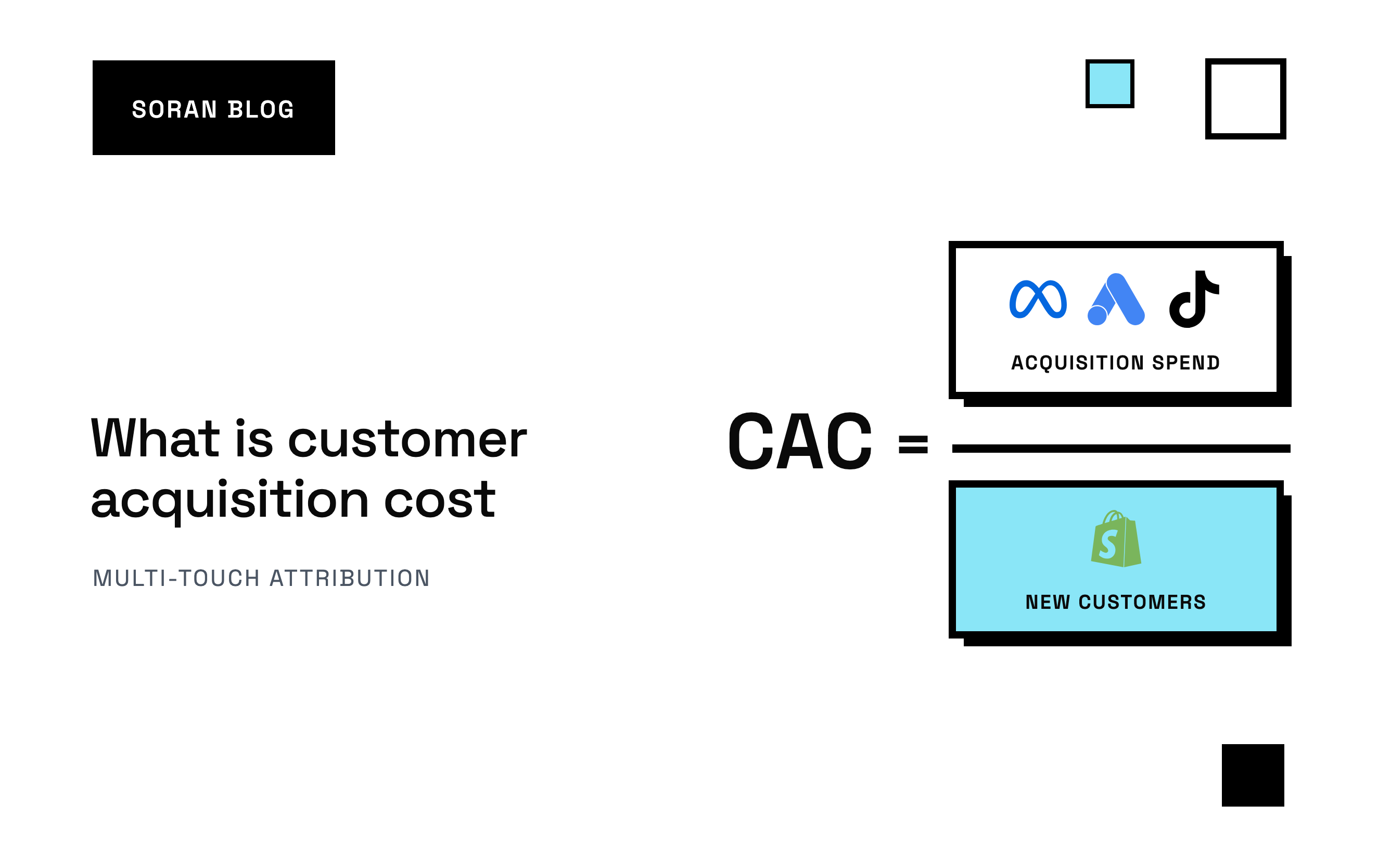
CAC = acquisition spend ÷ number of new customers acquired
If you spent $20,000 on marketing last month and 400 people bought from you for the first time, your CAC is $50. On average, each new customer cost you $50 to get.
The important word is new. CAC is about first-time buyers: people who had never ordered from you before. Someone placing their third order isn't being acquired. You already have them.
That's what makes CAC different from most ad metrics. ROAS, CPA (cost per acquisition, your spend divided by the number of orders) and the conversions ad platforms report all count orders or revenue, and they don't care whether the buyer is new or returning. CAC only counts the people who make your customer base bigger.
Why CAC matters so much for an online store
It tells you what growth actually costs
Every store has two ways to make more money: get existing customers to buy more, or get more customers. CAC is the price tag on the second one. If you want to add 1,000 customers next quarter and your CAC is $60, you need roughly $60,000 of acquisition spend, assuming CAC holds as you scale. It often doesn't: as you spend more on a channel, you run out of the easiest buyers and each extra customer costs more.
It catches problems ROAS hides
Say a store's ROAS holds steady at 3 for six months. Looks stable. But underneath:
- In January, half the attributed revenue came from first-time buyers.
- By June, only a quarter did. The rest is past customers clicking a retargeting ad (an ad shown to people who have already visited or bought) on their way to buying anyway.
ROAS didn't move, but the ads are doing far less to grow the business. CAC would have shown it: fewer new customers for the same spend means a higher cost per new customer.
CAC vs CPA vs ROAS: what's the difference?
These three get mixed up constantly, so here's how they relate.
| Metric | What it measures | Counts returning customers? |
|---|---|---|
| CAC | Spend divided by new customers won | No |
| CPA | Spend divided by conversions (usually orders) | Yes |
| ROAS | Revenue from ads divided by ad spend | Yes |
CPA (cost per acquisition, sometimes cost per action) counts every conversion. If one customer orders three times from three ad clicks, that's three acquisitions to CPA. To CAC, it's one customer, and only if this was their first order.
ROAS is revenue divided by spend. It's about money in versus money out, with no idea who the buyer was.
You need all three, but they answer different questions. ROAS and CPA tell you whether a campaign is efficient at producing orders. CAC tells you whether your marketing is efficient at producing customers.
How to calculate customer acquisition cost, step by step
The division is the easy part. The hard part is deciding what goes on each side, because those choices can honestly make the same store's CAC come out at $32 or $78. Here's how to get both inputs right.
Step 1: pick your time period
Both numbers have to cover the same window. A calendar month is the most common because it lines up with your ad billing and your accounting.
- Short windows are noisy. A single week can swing wildly because of one promotion or one viral post. Use weeks for watching trends, months for reporting.
- Long buying cycles need longer windows. If people think about your product for a few weeks before buying, a lot of this month's spend is winning next month's customers. Spend ramps up one month, customers arrive the next, and it looks like CAC spiked and then crashed. A rolling 90-day CAC (spend over the last 90 days divided by new customers over the last 90 days) evens this out.
- Keep it consistent. Comparing a 30-day CAC to a 90-day CAC tells you nothing.
Step 2: add up your acquisition spend
This is the top of the fraction. At minimum, include the actual billed ad spend from each platform aimed at winning new customers: Meta, TikTok, Google, Pinterest and so on.
Most stores get a more realistic number by also including:
- Agency or freelancer fees for running paid acquisition.
- Creative costs: photo and video shoots, UGC (user-generated content) creators, designers working on ads.
- Influencer and affiliate payouts tied to new customers.
- First-order discounts, like a "10% off your first order" code. That's money you gave up specifically to win a new customer.
- Acquisition tools, such as software used mainly to run ads.
Leave out spending aimed at customers you already have: email and SMS to your existing list, loyalty and referral rewards for repeat buyers, and retargeting campaigns that only show to past customers (if you can separate them). Those are retention costs. Mixing them in makes acquisition look more expensive than it is.
Should you include salaries? Adding a share of your marketing team's pay gives a fully loaded CAC. It's the right number for a long-term business plan or an investor deck. For week-to-week ad decisions, most teams use ad spend (sometimes plus agency fees), because that version reacts to the decisions you're actually making.
There's no single correct definition. What matters is that you pick one, write it down and use it every time. A CAC that includes agency fees in March and excludes them in April will look like it improved when nothing changed.
Step 3: count your new customers, not your orders
This is the bottom of the fraction, and it's where most CAC calculations quietly go wrong. You want the number of people who placed their first ever order with you during the period. Not total orders. Not every customer who ordered. Not "new customers" as an ad platform reports them.
- Start from your store, not your ad platforms. Your store knows who has bought before. Ad platforms only know who clicked.
- Filter to first orders. In Shopify's analytics, the new vs returning customer sales report splits first-time buyers from repeat ones. Count customers whose very first order falls inside your period. Don't filter on "order count is 1": someone who first bought on the 3rd and again on the 20th is still a new customer for that month.
- Net out full refunds. A customer who returned everything wasn't really acquired. If your return rate is high, count net new customers.
- Watch out for duplicates. Someone who buys as a guest on their phone, then again on their laptop with a different email, looks like two new customers. Without a way to recognize them as the same person, your CAC looks lower than it is. Clean customer matching matters more for CAC than for almost any other metric.
Step 4: divide, then break it down
Divide spend by new customers. Then do it again by channel, because a single blended number hides a lot. The next section shows how.
Worked example: blended, paid and channel CAC for one store
Let's take a made-up home goods store, Harbor & Pine, and calculate its CAC for September three ways. The numbers are illustrative.
| Item | Amount |
|---|---|
| Meta ad spend | $18,000 |
| TikTok ad spend | $6,000 |
| Agency fee (manages both) | $3,000 |
| Creative production | $2,000 |
| Welcome discount given to new customers | $1,500 |
| Total orders | 1,400 |
| First-time customers (from the store) | 520 |
Blended CAC
Blended CAC takes all your acquisition spend and divides it by all your new customers, however they found you. Paid ads, organic search, word of mouth: it all goes in the same bucket.
$18,000 + $6,000 + $3,000 + $2,000 + $1,500 = $30,500
$30,500 ÷ 520 = about $58.65 blended CAC
This is the most honest number for the business as a whole, because it doesn't depend on tracking which channel did what. Its weakness is that it can't tell you which channel to scale or cut.
Paid CAC
Paid CAC uses only paid spend and only the new customers who came from paid ads. That depends on attribution, meaning how you decide which marketing gets credit for a sale. Say attribution shows 360 of the 520 came through paid ads and 160 through organic search, word of mouth and other unpaid routes.
- Ad spend only: ($18,000 + $6,000) ÷ 360 = about $66.67
- Including agency and creative: ($18,000 + $6,000 + $3,000 + $2,000) ÷ 360 = about $80.56
Paid CAC is higher than blended, and that's normal. Blended CAC gets a "free" boost from customers who found you without ads. Paid CAC tells you what buying a customer really costs.
Channel CAC
Channel CAC splits paid CAC by platform, or further, by campaign. This is the version you actually make budget decisions with. Say attribution assigns the 360 paid new customers as 270 to Meta and 90 to TikTok.
- Meta CAC: $18,000 ÷ 270 = about $66.67
- TikTok CAC: $6,000 ÷ 90 = about $66.67
On cost per new customer the two channels are dead even, even if one has much higher ROAS. You can also share agency and creative costs out by spend if you want fully loaded channel CACs.
The mistake version: dividing by orders
Now watch what happens if someone divides the same spend by total orders:
$30,500 ÷ 1,400 = about $21.79
That's not CAC. That's cost per order, and it's less than half the real number. If Harbor & Pine planned its growth around a $22 CAC, it would be badly surprised.
Getting channel CAC right: the attribution problem
Blended CAC only needs your total spend and your store's new customer count. Channel CAC needs one more thing: knowing which channel each new customer came from. And that's where it gets tricky.
Say Maya sees your TikTok ad on Monday, clicks a Meta ad on Wednesday and buys on Friday after searching your brand name. Who acquired her?
- Ask TikTok and it may claim her.
- Ask Meta and it may also claim her .
- Ask a last-click report (one that gives all the credit to the final click before the purchase) and it gives her to organic search.
Multiply that across a month. For Harbor & Pine, Meta might claim 320 new customers and TikTok 140. That's 460, but only 360 came through paid ads at all. Use those platform numbers and both channels look cheaper than they are:
- Meta: $18,000 ÷ 320 = $56.25 (versus $66.67)
- TikTok: $6,000 ÷ 140 = $42.86 (versus $66.67)
Now TikTok looks dramatically better, and you'd shift budget to it based on double counting.
The fix is to count each new customer once and split their credit across the channels that touched them. That's what multi-touch attribution does, and the pros and cons of last-click attribution covers why the default view often shortchanges the ads that start a journey. Whichever model you use, your per-channel customer counts should add up to your real number of paid new customers, never more.
What is the average customer acquisition cost for ecommerce?
You spent $12,000 on ads last month and want to know if that was good. So you search for the average customer acquisition cost for ecommerce and find a dozen articles, each with a different figure, none saying where it came from.
The honest answer: an industry average won't tell you much. CAC depends on things that are specific to your store:
- Your price point. A higher-priced product usually needs more convincing, more touchpoints (separate moments a shopper sees or clicks something from you, like an ad, an email or a search result) and more spend per buyer. That's fine if the order is worth it.
- Your margins. A $60 CAC is a disaster on a product that earns you $20 per order and comfortable on one that earns you $150.
- Your repeat rate. If customers come back five times, you can afford to pay more for the first purchase than a store selling something people buy once.
- What's counted as spend. Ad spend only, or agency, creative, software and staff too. Same store, very different CAC.
- How "new customer" is defined. Some tools count every order, some every first-time email, some every first-time device.
A store selling $25 phone cases and a store selling $900 mattresses live in different worlds. When you see an average with no explanation of these choices, you can't tell whether you're comparing like with like. The useful benchmarks are your own CAC over time, and your CAC compared to what a customer is worth to you.
What is a good customer acquisition cost?
A CAC number on its own means nothing. It becomes useful next to what that customer brings in. There are three ways to look at it. Let's use a made-up skincare store with a $34 paid CAC.
First-order profit
Take the profit from a new customer's first order: revenue minus discounts, cost of goods, shipping and payment fees. This is close to contribution margin, the money left after the costs of making and delivering the sale.
If the skincare store's average first order is $55 and leaves $26 of contribution margin, a $34 CAC means it loses $8 on every new customer's first purchase. That can be fine, but only if they come back.
Customer lifetime value
Customer lifetime value (LTV or CLV) is the total profit you expect from a customer over the whole time they buy from you. If the average skincare customer orders four times and each order leaves $26, their lifetime value is around $104.
Now the $34 CAC looks very different: you spend $34 to win about $104. You'll often see a lifetime value to CAC ratio of 3 to 1 quoted as a target. Treat it as a rule of thumb, not a law, because it depends on how fast customers return and how sure you are about your lifetime value estimate. Our guide on how to calculate your customer lifetime value walks through that side of the math.
Compare like with like. If your CAC is measured in ad dollars, compare it to lifetime profit, not lifetime revenue. A customer worth $200 in revenue at 40% margins is worth $80 to you, not $200.
Payback period
The payback period is how long it takes for a customer's profit to cover what you spent to win them. Here the first order leaves $26 against a $34 CAC, so the customer pays you back partway through their second order. If that usually comes within two months, payback is about two months.
Payback matters for cash flow. A great lifetime value that takes 18 months to arrive can still sink a store that can't fund the gap.
Common mistakes that distort CAC
- Dividing by orders instead of new customers. The most common error, and it makes CAC look far better than it is.
- Adding up every ad platform's reported customers. They overlap. Channel totals should never exceed the new customers your store actually got.
- Counting returning customers as new because of guest checkouts, second emails or new devices.
- Mismatched time periods. Spend from one month divided by customers from a different window is meaningless.
- Changing the definition of spend from month to month.
- Mixing in retention spend. Email and loyalty costs belong to keeping customers, not winning them.
- Looking only at the average. A blended CAC of $45 might be $25 on one channel and $110 on another. The average says the business is fine. The breakdown says where money is going to waste.
- Counting discount-driven buyers the same as full-price ones. A customer won with 40% off is worth very different money from one who paid full price. Look at first-order margin, not just first-order count.
- Chasing a lower CAC at any cost. The cheapest customers are often the least valuable. A channel with a higher CAC can still be the better one if its customers come back more.
How to bring CAC down without just cutting spend
Cutting spend usually lowers CAC, because you stop buying the most expensive customers first. But it also shrinks growth. A few ways to improve CAC that don't just mean doing less:
- Find out which channels actually bring new customers. Per-channel CAC with honest attribution is the starting point. Many stores find a channel that looks great on ROAS is mostly reaching people who already buy.
- Separate prospecting from retargeting. Prospecting means ads aimed at people who don't know you yet. Retargeting tends to show strong ROAS, but much of it reaches people already on their way to buying. Judge prospecting campaigns on new customers, not on revenue.
- Improve your conversion rate. If more of the visitors you pay for end up buying, every new customer costs less. Product pages, shipping clarity and checkout speed all feed directly into CAC.
- Feed the ad platforms better data. Platforms optimize toward the conversions they can see . If they see more of your real purchases, they get better at finding buyers like your real customers. Sending purchases from your store's server, so they don't depend on the shopper's browser, is one way to do that; see server-side tracking for Shopify .
- Raise what a customer is worth. Strictly, this doesn't lower CAC, but it changes what you can afford. Better retention (see what is customer retention rate ) or higher first-order value both let you pay more for a customer and stay profitable.
A quick checklist for calculating your real CAC
- Choose a period: a month, or a rolling 90 days for longer buying cycles.
- Write down your spend definition: ad spend only, ad spend plus agency and creative, or fully loaded.
- Pull actual billed spend from each ad platform and add your other included costs.
- Count first-time customers from your store, net of full refunds, and de-duplicate where you can.
- Calculate blended CAC, then paid CAC, then channel CAC using attribution that counts each new customer once.
- Compare CAC to first-order margin and lifetime value, in profit, not revenue.
- Work out your payback period and check you can fund it.
- Track it monthly. Your own trend is the benchmark that matters.
How Soran handles it
Soran is built for the hard half of CAC: knowing who is really new, and which ads really won them, without the platforms double counting.
- New customers are counted once. Customer profiles join orders, visits and touchpoints from different devices into one person, and repeat revenue is shown apart from first purchases. So a returning customer on a new laptop is far less likely to be counted as new.
- Credit is split once. Multi-touch attribution splits each order across the visits that led to it, so channel totals add up to what the store actually took, not the sum of every platform's claims. You can switch between models and every number updates.
- New-customer metrics per channel and campaign. Alongside ROAS and CPA, Soran shows new customers, new-customer revenue, new-customer CPA (your cost per new customer) and new-customer ROAS at the channel, campaign, ad set and ad level, with spend matched to the exact ad behind each order.
- Profit sits next to cost. Revenue steps down through discounts, refunds, cost of goods, shipping and fees, so you can compare what a customer cost to what their orders actually left you.
- Honest gaps. Spend is pulled in from Meta and TikTok. If a channel shows revenue but no spend, Soran flags it as a probable unconnected ad account instead of showing a flattering number. Other costs, like agency fees, you'd still add on top for a fully loaded figure.
Frequently asked questions
What does CAC stand for?
CAC stands for customer acquisition cost: the average amount you spend to win one new customer. It's sometimes called cost per acquisition, but that term (CPA) usually counts every conversion, including repeat orders, so it isn't quite the same thing.
What is the formula for customer acquisition cost?
CAC = acquisition spend ÷ number of new customers acquired, with both numbers covering the same time period. For example, $12,000 of acquisition spend and 240 new customers gives a CAC of $50.
What's the difference between CAC and CPA?
CAC divides spend by new customers. CPA divides spend by conversions, which usually includes orders from returning customers. Because repeat buyers are cheaper to bring back, CPA is almost always lower, and using it in place of CAC makes your acquisition look cheaper than it is.
What is a good customer acquisition cost?
There's no universal good number, because it depends on what a customer is worth to you. If lifetime profit comfortably exceeds CAC and you earn it back fast enough to fund your growth, your CAC is working.
Is there a good average CAC for Shopify stores?
Not one that applies to your store. CAC depends on price, margin, repeat rate and what you count as spend. The useful question is whether your CAC is comfortably below what a customer is worth to you, and whether it's moving in the right direction.
Do I use ad platform data or store data to count new customers?
Your store's data. Your store knows who has bought before; ad platforms don't, and each one claims credit for customers that others also claim. Use ad platforms for the spend side, not the customer count.
Should I include organic customers in CAC?
For blended CAC, yes. It shows what growth costs the whole business. For channel CAC, no: each channel's spend should be divided only by the customers that channel helped acquire.
Should CAC include agency fees and creative costs?
Many stores include them, because they're real costs of winning customers. Others keep CAC to ad spend only and track the rest separately. Either is fine as long as you stick to one definition, so changes in the number reflect reality and not a change in what you counted.
How often should I calculate CAC?
Monthly is the most common, because it lines up with ad billing. Look at a rolling three-month view too, so one unusual month doesn't send you in the wrong direction, especially if customers take weeks to decide.
Why does my CAC go up as I spend more?
Usually because the easiest buyers get reached first. As you scale a channel, you reach people who need more convincing, so each extra customer costs more. Watching CAC alongside first-order margin and payback tells you where that stops being worth it.
Want to see what a new customer really costs on each of your channels? Book a demo and we'll walk through it on your store's data.