
Add up the sales Meta says it drove last month. Add the sales TikTok claims, then Google, then your email tool. If you're like most stores running ads, the total is bigger than the number of orders Shopify actually took. Sometimes a lot bigger.
That's the problem marketing attribution exists to solve. It's how you work out which ads, channels and campaigns actually earned each sale, so you can spend more on what works and stop paying for what doesn't. This guide explains what attribution means in marketing, how it works under the hood, where it goes wrong, and how to set it up so the numbers add up.
What does attribution mean in marketing?
In plain words, attribution means giving credit. Marketing attribution is the practice of looking at a sale and deciding which of your marketing efforts deserve credit for it.
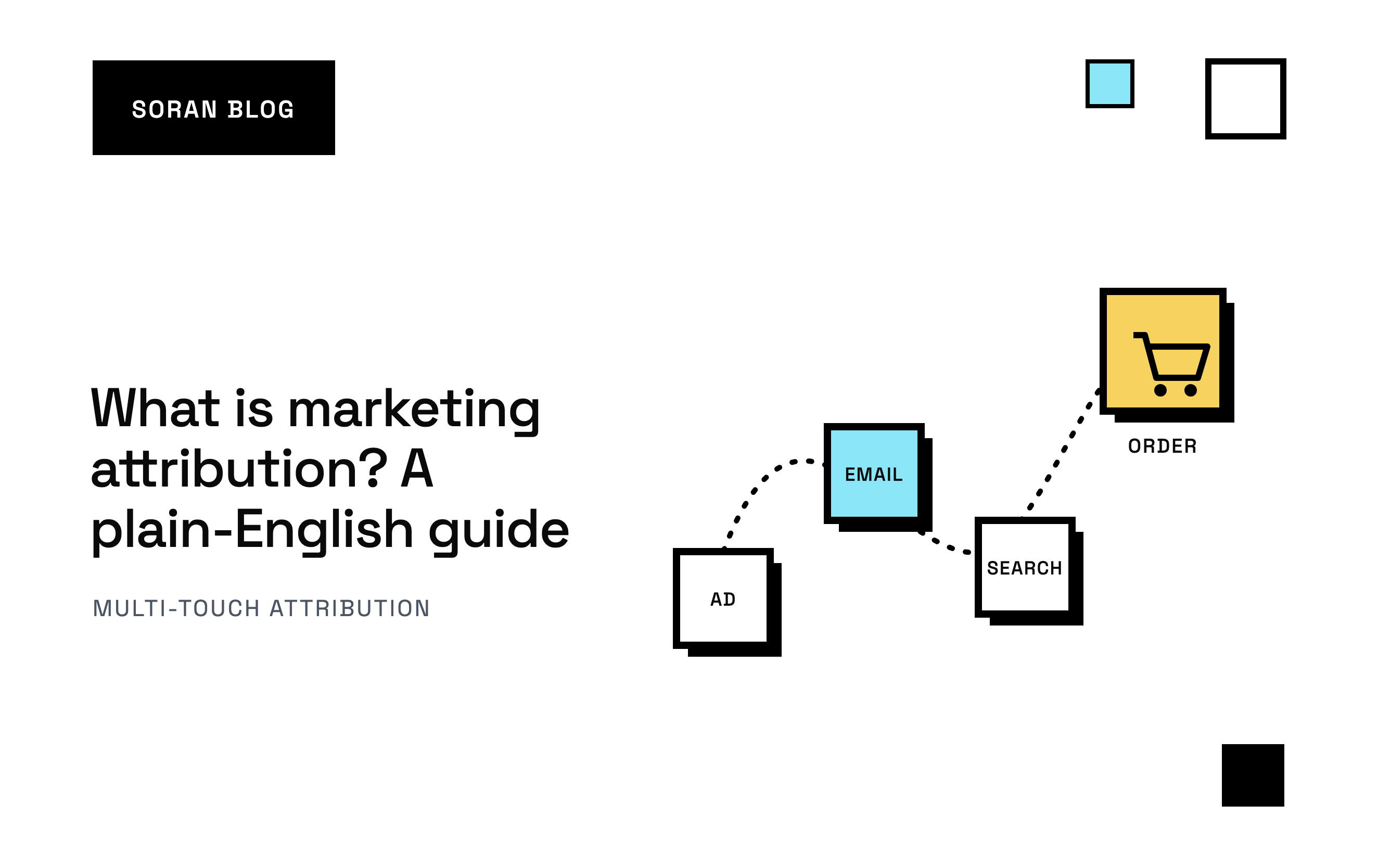
That sounds simple when a shopper clicks one ad and buys straight away. It gets harder fast, because most people don't buy like that. Here's a typical journey:
- Monday: Sarah sees your ad on Instagram while scrolling on her phone. She taps it, looks around, and leaves.
- Thursday: She searches your brand name on Google and lands on a product page. Still not ready.
- The next week: She opens your welcome email on her laptop, clicks through and buys.
Which one made the sale? Instagram introduced you. Google brought her back. Email closed it. Each of those channels has a reasonable claim, and each of them will tell you, in its own dashboard, that the sale was theirs.
Each step in that journey is called a touchpoint: any moment a shopper interacts with your brand, like an ad click, a search visit or an email open. Marketing attribution is the set of rules you use to split credit across those touchpoints.
Why attribution matters for an online store
You can run a store without attribution. You just end up making budget decisions on guesses. Here's what good attribution changes:
- You know where to put the next dollar. If you can see that one campaign brings in profitable first-time buyers and another mostly reaches people who were going to buy anyway, the budget decision makes itself.
- You stop double-paying for credit. When every platform claims the same order, every platform looks profitable. Attribution gives you one number per order, so the totals add up to your real revenue.
- You see the channels that start journeys. Ads that introduce new customers rarely get the final click. Without attribution, they look like they don't work and get cut, and a few weeks later your "efficient" bottom-of-funnel campaigns run out of people to close.
- You can judge creative and audiences, not just channels. Good attribution goes down to the campaign, ad set and individual ad.
Why every ad platform's numbers disagree
Before getting into how attribution works, it helps to understand why the platforms' own reports can't be added together.
Each ad platform only sees its own touchpoints. Meta knows Sarah tapped an Instagram ad. It has no idea she also searched on Google or clicked an email. So when she buys, Meta looks at its own records, sees a recent ad interaction, and counts the sale. Google does the same thing with the search visit. Your email tool does the same with the email click.
On top of that, each platform uses its own attribution window: the number of days after a click (or a view) during which it will still take credit for a sale. Different windows, different counting rules, and no shared view of the customer means three platforms can each honestly report one sale, for an order that only happened once.
That's not the platforms lying. It's that none of them can see the whole journey. To get one honest answer, you need a view that sits above all of them.
How marketing attribution works
Attribution comes down to three steps. Every tool does some version of them, and the quality of each step decides whether you can trust the result.
Step 1: Capture every touchpoint
First you need a record of each visit and where it came from. Usually that means a small piece of code on your site that notes every page view along with its source: the ad, the email, the search or the link that brought the shopper in.
Ads carry that source information in the link itself. UTM parameters are short tags added to the end of a URL (like ?utm_source=facebook&utm_campaign=spring-sale) that tell your analytics where a click came from. Ad platforms also add their own click IDs, a unique code attached to each ad click, like fbclid for Meta or gclid for Google.
If a touchpoint isn't captured here, no model downstream can give it credit. This is where ad blockers and browser privacy features do their damage, which is why many stores now record purchases on the server (the store's own computers, not the shopper's browser) so the sale itself is never lost.
Step 2: Connect the touchpoints to one person and one order
Next, the visits need to be linked to the person who eventually bought, and to their order. This is harder than it sounds. Sarah used her phone on Monday and her laptop the following week. Unless something links those two devices to the same person, they look like two strangers, and the Instagram ad loses its credit.
The common way to link them is an identifier the shopper gives you, like an email address at checkout or a login. Once you know the phone visitor and the laptop buyer are the same person, the whole journey lines up.
Step 3: Split the credit with an attribution model
Finally, you apply an attribution model: the rule that decides how much credit each touchpoint gets. A few common ones:
- Last touch: the final touchpoint before the purchase gets all the credit. In Sarah's case, email.
- First touch: the first touchpoint gets all of it. Instagram.
- Linear: every touchpoint gets an equal share. A third each.
- Position based (U-shaped): the first and last touchpoints get most of the credit, and the ones in the middle share the rest. We explain it in detail in what is the U-shaped attribution model .
- Time decay: touchpoints closer to the purchase get more credit than older ones.
Models that use one touchpoint are called single-touch. Models that spread credit across several are called multi-touch, which we cover in depth in what is multi-touch attribution .
A worked example: one month, three models
Let's make this concrete with made-up numbers. Imagine a store that took 100 orders worth $10,000 last month, all from shoppers with journeys like Sarah's. Here's how the credit for that $10,000 lands under three models:
| Channel | Last touch | First touch | Linear |
|---|---|---|---|
| Meta ads | $2,000 | $6,000 | $3,800 |
| | $3,000 | $2,500 | $3,000 |
| | $5,000 | $1,500 | $3,200 |
| Total | $10,000 | $10,000 | $10,000 |
Three things to notice:
- Every column adds up to $10,000. That's the point of doing attribution yourself. Each order's credit is split once, so the total matches what the store actually took. Compare that with adding up the platforms' own reports, which could easily claim $15,000 or more for the same month.
- The story changes a lot by model. Under last touch, email looks like the hero and Meta looks weak. Under first touch, Meta is doing most of the work. Neither is "the truth". They answer different questions: last touch asks "what closed the sale?" and first touch asks "what started it?"
- The decision depends on the question. If you cut Meta because of its last-touch number, you'd likely starve the top of your funnel. Looking at both views protects you from that mistake.
Now add ad spend. Say Meta cost $2,500 that month. Its ROAS (return on ad spend: revenue credited to an ad divided by what you spent on it) is 0.8 under last touch and 2.4 under first touch. Same spend, same orders, a completely different verdict. That's why the model you choose matters so much.
Common marketing attribution mistakes
Adding up the platforms' own numbers
This is the most common one. Each platform's report is useful for optimizing inside that platform. It isn't a measure of total impact, and summing them double counts any order that touched more than one channel.
Trusting last click by default
Last click is the default in a lot of tools because it's simple. It systematically undervalues the ads that introduce people to your brand. We go through the trade-offs in the pros and cons of last-click attribution .
Inconsistent UTM tags
If one campaign is tagged facebook, another Facebook and a third fb, they show up as three different sources. Pick one naming scheme and stick to it, ideally written down where everyone on the team can find it.
Losing the purchase itself
If your tracking only runs in the browser, some purchases never get recorded at all: the shopper had an ad blocker, or closed the tab before the thank-you page loaded. Attribution can't credit a sale it never saw. Server-side tracking for Shopify explains how to fix this.
Ignoring spend you haven't connected
ROAS is revenue divided by spend. If one ad account isn't connected to your attribution tool, its revenue still shows up (through clicks with tags), but its spend doesn't, so its ROAS looks infinite. Any channel with revenue and zero spend deserves a second look.
Expecting attribution to prove cause
Attribution tells you which touchpoints were present before a sale. It doesn't prove the sale wouldn't have happened without them. Someone who was already going to buy might still click a retargeting ad on the way. Answering "did this ad cause extra sales?" takes a different method, like a holdout test, where you deliberately don't show ads to a group and compare.
How to get started with marketing attribution
Here's a practical order to work in:
- Decide what counts as a conversion. For most stores it's a purchase, but be explicit, and decide what it's worth (order value, or margin).
- Tag every ad link consistently. Use UTM parameters on every campaign, with one naming scheme for source, medium and campaign.
- Record purchases on the server. Make sure every order is captured, even when the browser drops it.
- Capture visits from day one. Attribution can only see journeys from the point tracking starts. It can't reconstruct visits from before it was installed.
- Connect your ad spend. Pull in spend from every ad account so ROAS covers everything you pay for.
- Start with two models side by side. Compare first touch and last touch. Where they disagree is where the interesting decisions are.
- Review at the campaign and ad level, not just the channel. "Meta works" is less useful than "these three ads bring in new customers profitably."
- Revisit monthly. Look at what changed, move budget in small steps, and watch what happens.
How Soran handles it

Revenue by channel group in Soran's attribution report, on a demo store.
Soran is attribution and profit analytics for ecommerce brands. It records every Shopify order on the server, so ad blockers and closed tabs don't lose sales, and it works out which visits led to each one.
Each order's credit is split once across the visits that led to it, so your totals add up to what the store actually took, not the sum of every platform's claims. You can switch between ten attribution models, including first touch, last touch, linear, position based and time decay, and every number in the report updates. Channel, campaign, ad set and ad views load together, and ad spend is matched to the exact ad behind each order, so ROAS is calculated at every level. If a channel shows revenue but no spend, Soran flags it as a probable unconnected ad account instead of showing a flattering number.
Frequently asked questions
What is marketing attribution in simple terms?
It's the process of deciding which of your ads, emails and other marketing efforts get credit for a sale. Instead of each platform claiming every order it touched, attribution gives each order one set of credit, split across the touchpoints that led to it.
What's the difference between attribution and an attribution model?
Attribution is the overall practice: capturing touchpoints, connecting them to orders, and assigning credit. The attribution model is the specific rule used in that last step, like "the last touchpoint gets everything" or "every touchpoint gets an equal share."
Which attribution model is best?
There isn't one right answer. Last touch is good at showing what closes sales, first touch at showing what starts them, and multi-touch models like linear or position based give a more balanced view. Most stores get the clearest picture by comparing two or three models on the same data.
Why doesn't my attribution tool match Meta Ads Manager?
Meta only sees its own ads, uses its own attribution window, and can count a sale that also touched other channels. An attribution tool looks at the whole journey and gives each order's credit once. The two will almost never match, and that's expected.
Can attribution track sales from before I installed it?
No. Your past orders can be imported, but the visits and ad clicks that led to them were never recorded, so there's nothing to attribute them to. Attribution starts working from the day tracking goes in, which is a good reason to set it up early.
Want to see which of your ads actually earn your sales? Book a demo and we'll walk through it on your store.